


🎧 Soundtrack for this story:
Stop This Train — John Mayer
Press play, then keep reading.
YouTube Music: Stop This Train
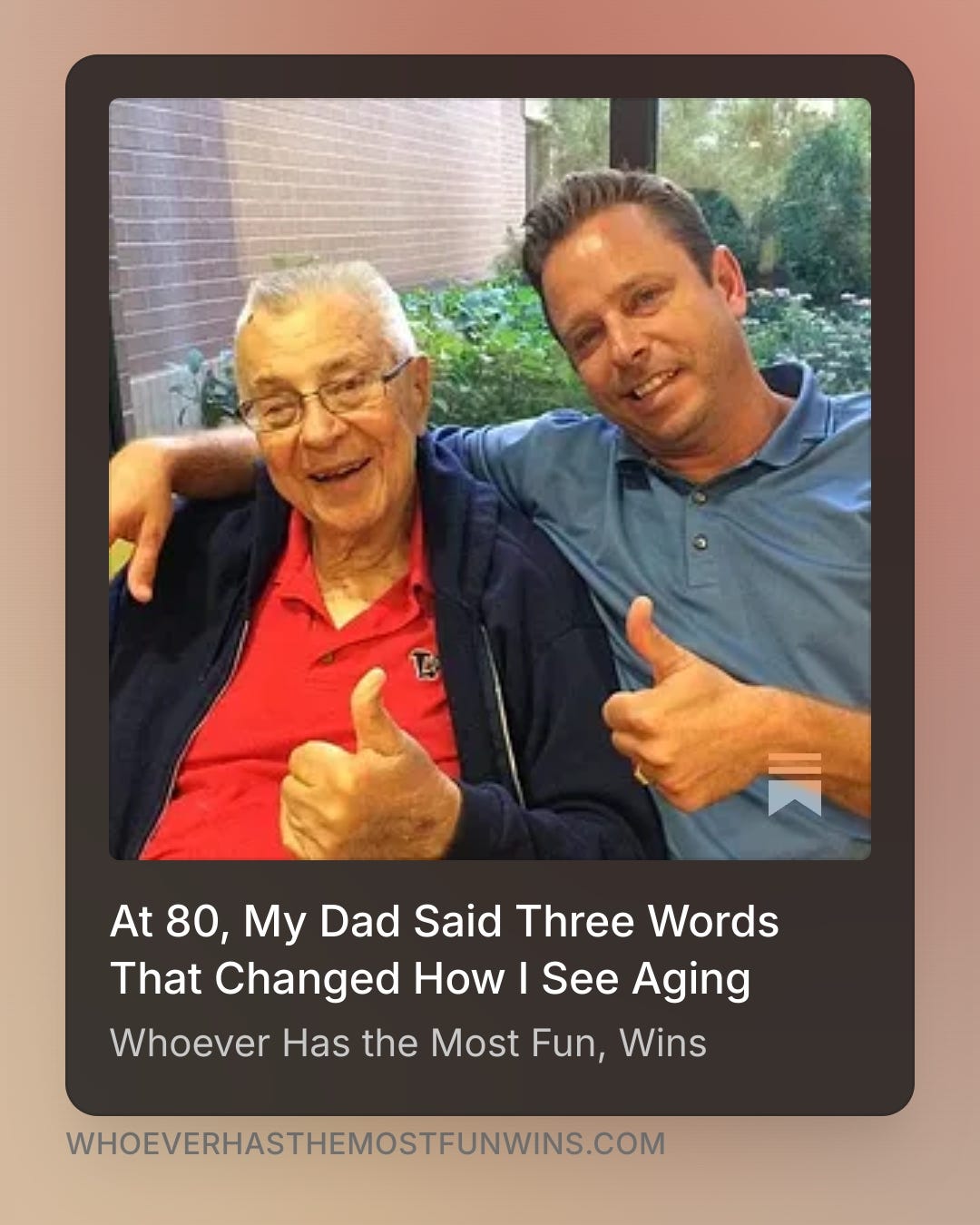
The 20-year-old, 35-year-old, 45-year-old and 60-year-old versions of us are all still rattling around inside the same person.
My Dad and I had a lot of deep conversations, especially at night. Night has a way of making men honest. The world quiets down. The distractions fall asleep. The bigger questions walk into the room.
During one of those talks, my dad said something I never forgot.
“I’d sign a contract if I could just live to 80 years old.”
I understood why he said it.
His dad died at 63. My dad knew the family history. He knew the risks. To him, 80 was not just an age. It was a victory. A summit. A finish line drawn beyond fear.
I smiled and nodded.
We laughed a little.
But I remembered.
Then, in 2012, my dad turned 80.
On his birthday, I reminded him of that old conversation.
“Dad,” I said, “you once told me you’d sign a contract if you could just live to 80. Well, here you are. So what do you do now?”
He looked at me.
He paused.
Then he smiled and said, “Time to renegotiate.”
I laughed out loud.
So did he.
But I have thought about that line ever since.
There is a lyric in John Mayer’s song “Stop This Train” that has been living inside me lately:
“I’m so scared of getting older. I’m only good at being young.”
It is one of those lines that does not just pass through your ears. It sits down somewhere inside you. It waits there. Years maybe. Quietly. Patiently. Then one day, when your knees make strange noises or your parents are gone or your own children are suddenly adults, the lyric raises its hand and says, Now do you understand me?
I do.
Me and My Dad — photo by author
I listen to a lot of music. Country, hip-hop, jazz, pop, instrumentals, songs I grew up with, songs my kids introduced me to, songs I pretended not to like until I found myself saving them to a playlist. I have been making custom playlists for probably 25 years now. Playlists for driving. Playlists for working out. Playlists for wine on the deck. Playlists for nostalgia. Playlists for moods I do not even know how to explain.
But I have always been a lyric person first.
The melody can pull me in, but the words are what make me stay. I listen for the sentence that feels like it somehow knows me. The line that sounds less written than discovered. The phrase that sneaks past all my defenses and taps on a memory I did not realize was unlocked.
Maybe that is one of the quiet truths of life. We spend the first part of it learning how to be young, and then just when we feel we have finally mastered it, life hands us a different assignment.
No instructions.
No practice round.
No gentle tutorial.
Just a calendar, a mirror, and the sudden realization that time has been moving faster than we thought.
My family history has always made time feel less like an abstract idea and more like something with teeth.
On my mom’s side, cancer seemed to be the shadow that followed too many people out of this life. On my dad’s side, it was heart disease. The heart, that stubborn little engine we trust without thinking, until one day someone we love proves how fragile it can be.
My dad’s dad, my Grandpa Joe, died at 63 after his third heart attack.
I was six years old.
Six is too young to understand death, but not too young to feel it. I remember him. I remember his humor. His storytelling. The kind of personality that could rearrange the air in a room. His funeral was the first one I ever attended, and though I did not fully understand what was happening, I understood enough to know that something permanent had entered my life.
Someone could be here.
And then not.
That was the first time time scared me.
It scared my dad too.
He was only 40 when his dad died. He was married to my mom and had six children. Six children ranging from 12 down to 3 years old. A house full of school papers, cereal bowls, sports schedules, laundry, scraped knees, laughter, arguments, and noise. So much noise.
Then, in the middle of all that life, his dad was gone.
Sixty-three years old.
When you are young, 63 sounds distant. Almost ancient.
Then one day you get closer to it, and the number changes shape.
It no longer sounds old.
It sounds unfinished.
My parents lived for their family. That is not poetic exaggeration. That is simply what they did. My mom volunteered at our schools, drove us to practices, games, activities, and everywhere else six children somehow needed to be. My dad coached many of our sports teams, served on boards for my sisters’ swim clubs, and showed up for just about everything.
They were always there.
When you are a child, you think that is normal.
You think parents just appear in bleachers. You think clean uniforms magically return to your drawer. You think rides happen, dinners happen, encouragement happens, love happens.
Then you get older and realize none of it just happened.
Someone chose it.
Again and again.
That is one of the strange gifts of aging. It lets you look backward with better eyes.
Years later, one of my son’s school assignments gave me one of the clearest views I ever had of my dad.
My son was about 12 years old at the time, and he had to interview a relative about their life. He prepared a list of questions about childhood, accomplishments, memories, and lessons learned. He chose my dad, his grandpa.
They were both excited.
My dad had lived the kind of life a young boy could easily admire. He was an outstanding baseball player and was drafted by the Detroit Tigers in 1952. He played professionally for six years. He later served in the military during the Korean War before marrying my mom in 1958.
There was plenty to ask about.
Baseball. The Tigers. The military. Marriage. Children. Life.
I filmed the interview with one of those old video cameras, back when recording a family moment required a machine roughly the size of a toaster and the confidence that you were pointing it in the right direction.
My son worked through his questions. My dad answered them all.
Then came the big one.
“Grandpa, what was the proudest moment of your life?”
My dad paused.
Then he closed his eyes.
I watched him through the camera lens. For maybe 30 seconds, he seemed to travel somewhere none of us could follow. It was as if he were walking through the rooms of his own life. Baseball fields. Military barracks. Wedding day. Children. Houses. Holidays. Good years. Hard years. Everything.
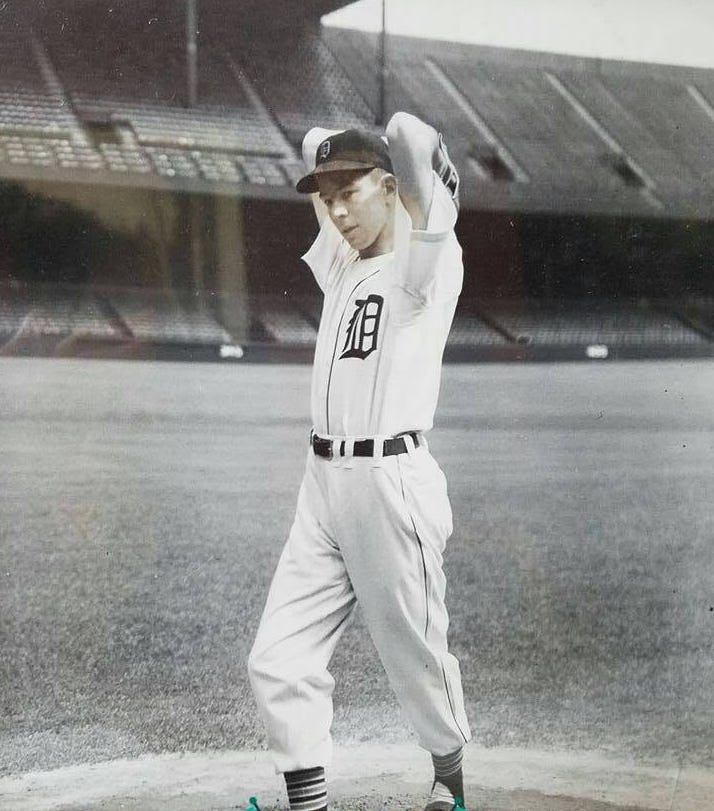
My Dad when he played for the Detroit Tigers
Then he opened his eyes.
“Marrying your grandma and raising six wonderful kids with her.”
That was it.
Not baseball.
Not being drafted by the Detroit Tigers.
Not professional sports.
Not military service.
Not something that could be written on a plaque or printed in a program.
His proudest moment was love.
His proudest accomplishment was family.
I remember my jaw dropping. Not because the answer shocked me, exactly, but because of how pure it was. How certain. How undressed by ego. He had been asked to measure the meaning of his life, and he did not reach for status. He reached for people.
That moment has stayed with me because I think it revealed something we spend much of our lives trying not to admit.
The most important things are rarely the loudest things.
The world teaches us to chase applause. Titles. Recognition. Money. Achievement. The visible proof that we mattered. But time, if we live long enough, becomes a brutal editor. It cuts away the extra words. It leaves the clean sentence.
Who did you love?
Who loved you back?
Who was better because you were here?
My dad’s health, like his own dad’s, became its own long negotiation with mortality. Heart disease followed him through the years. Surgeries. A triple bypass. A heart attack he survived. The kind of medical history that makes birthdays feel less automatic.
When my Dad said those words: “time to renegotiate” it was funny, yes. But it was also profound in the way the best humor often is. My dad had reached the age he once would have accepted as enough. He had arrived at the finish line he once hoped for.
And once he got there, he wanted more.
Not because he was greedy.
Because he was alive.
That is the holy absurdity of being human. We make bargains with time and then, when time honors them, we ask for an extension.
One more birthday.
One more summer.
One more conversation.
One more ordinary afternoon that will not feel precious until later.
Not long after that, my dad’s heart required another serious procedure. His cardiologist called a family meeting. My sister Sally and I were there with him in one of those sterile medical rooms where the fluorescent lights seem to hum with worry.
The doctor explained the risks. The complications. The seriousness of it all.
Then he looked at my dad and asked him a question that changed the entire room.
“Ron, with all of these risks, why would you want this surgery?”
There was a silence.
Not an empty silence.
A full one.
My dad looked at me. Then at my sister. We stayed quiet, because somehow, we knew this was not our question to answer.
His lip trembled.
Then he looked at the doctor and said, slowly and clearly:
“Because I want to live…… I want to live.”
The doctor smiled.
That, he said, was exactly what he needed to hear.
The surgery gave my dad three more years.
He died in 2015 at the age of 83.
Three years past the contract.
Three years after the renegotiation.
Three more years of life he chose to fight for.
I think about that when I hear the John Mayer lyric.
“I’m so scared of getting older. I’m only good at being young.”
I think most of us feel that in some private corner of ourselves.
We fear getting older because aging feels like loss. Loss of speed. Loss of strength. Loss of possibility. Loss of the version of ourselves we still carry around inside, even when the mirror insists on introducing us to someone else.
Inside, most of us are still many ages at once.
We are the child at the funeral.
The teenager with impossible dreams.
The young parent trying to figure it out.
The adult watching our own children grow.
The son or daughter realizing our parents were never as permanent as they seemed.
Aging does not erase those versions of us. It stacks them. We carry them all. That is why time feels so strange. We are not one age. We are a whole crowded house of former selves.
And every once in a while, a song opens the door and lets them all speak.
Maybe we are not only good at being young.
Maybe we are simply inexperienced at being older.
Maybe aging is not something we are supposed to master. Maybe it is something we are supposed to keep renegotiating.
With our bodies.
With our fears.
With our memories.
With our regrets.
With the people we love.
With the dreams that changed shape.
With the dreams that still quietly wait for us.
My dad taught me that age is not just a number. It is a question.
What do you still want?
Who do you still love?
What are you not finished with yet?
He taught me that a life is not measured only by what we accomplish, but by what we refuse to stop caring about. He wanted to live because he was still connected to this world. Still invested. Still curious. Still attached to the people around him by invisible threads strong enough to pull him through fear.
I still hear him sometimes. Not in a supernatural way. In a human way. In the way a father’s voice can stay in a son’s bones.
“Time to renegotiate.”
Maybe that is all aging really is. Not stopping the train. Not pretending we are still young. Just waking up each morning, looking at what remains, loving it harder, and asking life, with whatever courage we have left:
What can we do with today?