
🎧 Soundtrack for this story:
Horse Whisperer— Thomas Newman
Press play, then keep reading.
YouTube Music: Horse Whisperer: Rhythm of the Horse
The Day a Horse Read My Mind
Stillness, Trust, Transformation — Hill Country, Texas
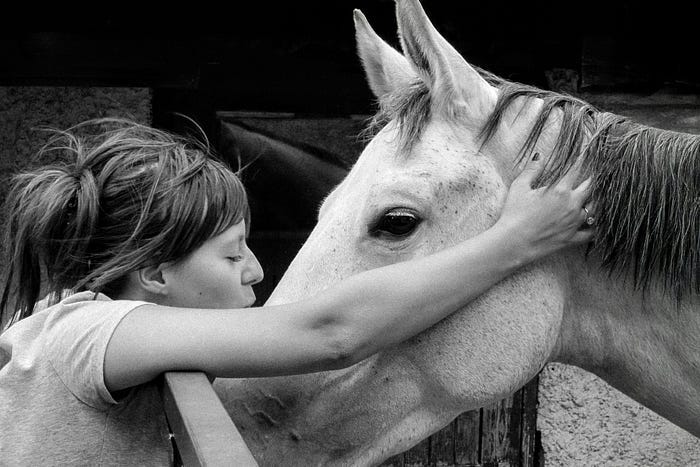
Photo by Christian Harb on Unsplash
“Don’t touch him yet.”
The rancher’s voice was calm, but it carried weight — the kind that comes from years of saying very little and meaning all of it.
The horse stood a few feet away — massive, silent, watchful. His dark eyes held mine with a kind of knowing I couldn’t quite place.
“Just stand there,” he said. “And breathe.”
It felt like the opposite of everything I’d ever learned about control. No commands. No reins. No effort to close the distance.
Just… presence.
Minutes passed — long enough for the noise in my head to begin dissolving into the quiet of the Texas Hill Country. Wind moved through the grass. A gate creaked somewhere behind us.
And slowly, almost imperceptibly, something shifted.
The horse took a step toward me.
Not because I asked him to.
Because something in me had changed first.
A Birthday Trip That Turned Into Something Else
There are travel experiences you enjoy…
…and then there are the ones that quietly rearrange something inside you.
The horse whispering session I stumbled into at Travaasa Experiential Resort — twenty miles north of Austin, tucked into the rugged folds of Texas Hill Country — was unmistakably the second kind.
I went in thinking it was just another unique activity to check off a list.
I walked out… not entirely the same person.
And if you had asked me why, I’m not sure I could have explained it.
It started, like most of the best things in my life, with a birthday.
Every year, I try to find something memorable for my wife Wendy — not just a place, but an experience. Good food is expected. Beautiful accommodations are standard.
What I’m chasing is something else entirely:
That one moment you’ll still be talking about years later.
Travaasa delivered from the second we turned off the highway and followed a long, winding ranch road into the hills. The world seemed to widen as we drove — cedar, limestone, open sky, and a quiet that felt earned.
The resort itself didn’t try too hard. It didn’t need to.
The food was outstanding. The rooms were beautiful. The activities list read like a playground for grown-ups: axe throwing (fun, slightly dangerous), rock climbing (humbling), BMX bike racing (Wendy’s idea… still questioning that one), plus spa time to remind our bodies we weren’t actually 25 anymore.
We felt adventurous. Satisfied.
And then, over breakfast one morning, everything shifted.
The Whisper That Pulled Us In
At the next table, a couple spoke in low, almost reverent tones.
“You have to do it,” the woman said.
“It’s not what you think,” the man added.
That was enough to hook me.
They weren’t talking about horseback riding. No saddles. No trails. No helmets.
“It’s about connection,” she said.
Connection.
That word can mean everything… or absolutely nothing.
Now, years before this trip, I had seen the movie The Horse Whisperer with Robert Redford and genuinely loved it. I’m an animal lover at heart, though my actual experience with horses had been limited to a few trail rides at various stables. Casual stuff. Nothing that would prepare me for what was coming.
But before I tell you about the corral in Texas, I need to tell you about Big Al.
Big Al, and the Limits of Control
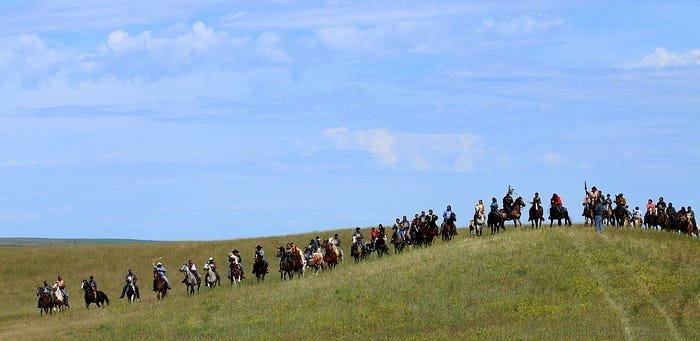
Photo by Daniel Lloyd Blunk-Fernández on Unsplash
Years ago, we took our kids to Double JJ Resort in Michigan — a fun, family-friendly place where even beginners could go horseback riding.
As we lined up, the rancher sized everyone up.
My wife and kids — honest people — said they were beginners and were paired with horses named Sunshine, Rainbow, and other confidence-boosting names.
Then I stepped up.
6’3”. 220 pounds. Feeling like I should probably represent the family well.
“Have you ridden before?” he asked.
I paused.
And then confidently exaggerated.
“Oh yeah… several times.”
He didn’t hesitate.
“Bring out Big Al!”
Big Al walked out like a veteran who had seen things. As I climbed on, he slowly turned his head and looked back at me — like he already knew how this story was going to end.
Then he let out a long, thunderous, unapologetic fart…
…and started walking.
That was it.
No response to the reins. No interest in my input. No negotiation.
Big Al had a plan.
I was not part of it.
That ride taught me something I didn’t fully appreciate at the time:
Control is mostly an illusion.
My wife and kids had a great time, though — which, in the end, was all that really mattered.
The Cowboy and the Corral
With Big Al’s memory firmly in mind, Wendy and I debated whether to sign up for the horse whispering experience. It had come highly recommended. We decided to go for it.
The next morning, he was waiting for us at the front of the resort.
There is a certain kind of man the American West produces — unhurried, economical with words, weathered by decades of outdoor work, possessed of a quiet authority that has nothing to do with volume. This cowboy was exactly that. He introduced himself beside his Dodge Ram pickup truck, shook our hands with the kind of firm, no-nonsense grip that tells you everything you need to know about a person, and drove us ten minutes down a winding road to his ranch, where an immaculate stable stood in the morning light and horses moved calmly in the paddocks beyond.
He didn’t offer much explanation on arrival. He asked if we had any experience with horses. This time — older, wiser, and remembering Big Al — I told the truth. He smiled like a man who appreciated that, told us to listen carefully, and walked us toward one of his horses.
Before we could do what instinct said to do — reach out, close the distance, make contact — he stopped us. He explained, with the patience of someone who has said this a hundred times but still means every word: never approach a horse from behind. Horses see in nearly all directions, but directly behind them is a blind spot, and what they feel in that blind spot is danger. Their response is ancient and immediate. You will get kicked. The horse will run. Any chance of trust will be gone before it started.
Always approach from the front. Slowly. Let them see you coming. Let them decide.
We followed his instructions, gently patting the horse on his head and sides — an introduction, the cowboy called it — and then he handed us each a soft brush.
“Groom him,” he said. “I’ll be back.”
And then he left.
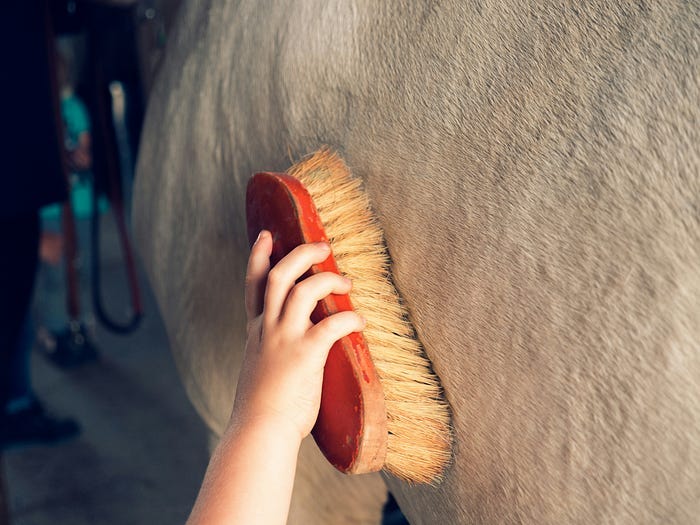
Photo by Chris Bair on Unsplash
For the next fifteen minutes, Wendy and I stood there in the morning sun, brushing this horse, slowly realizing that we appeared to be paying good money to do someone else’s chores. We laughed about this. We genuinely did not mind. The horse leaned into the brush strokes. His eyes grew soft and half-closed. The three of us fell into a quiet, unhurried rhythm, and something in the air around us changed — loosened — in a way that was hard to name.
When the cowboy returned, he told us a story while instructing us to keep brushing. He described the Native Americans of the old West, who initially tried to capture wild horses the way you might expect — approaching from behind, quick and decisive, relying on surprise. It went badly every time. The horses sensed them through peripheral vision, kicked out, and bolted. Trust was never possible.
Over generations, they discovered a different way. Approach from the front. Hand extended, palm open. Stand still and let the horse look at you. Stroke the forehead, the cheeks, the flanks — slowly, without urgency or agenda. Earn the trust first. Then, and only then, gently slip a rope around the neck and walk them home.
It was an evolution born entirely of respect. And it worked every time.
The cowboy let that land for a moment. Then he looked at us and asked: “Who wants to go first?”
Wendy looked at me with fear in her eyes. I looked at the circular corral. I performed my most convincing impression of a man who is absolutely not nervous.
“I’ll go,” I said.
The Moment Everything Changed
The corral was perhaps sixty feet across, its wooden fence worn smooth by years of use. The cowboy handed me a schooling whip — short, light, built for signaling rather than striking — and told me to stand in the center and not move. Then he disappeared through a gate on the far side of the corral and returned leading a large, unsaddled horse into the space.
The gate closed behind the horse.
The cowboy stepped outside the fence.
It was just the two of us.
The horse was stunning — dark, powerfully built, radiating the kind of calm, controlled energy that makes you hyper-aware of your own nervous system. He stood across the corral and studied me with those extraordinary eyes — eyes that seem to see not just you, but through you, past the clothes and the bravado and the held breath, to whatever is actually going on underneath.
I tried to look calm. I was not calm.
“Walk toward him,” the cowboy said from outside the fence. “Whip raised. Stay to his left.”
I raised the whip and walked forward. The horse’s eyes widened slightly — not in fear, but in sharp, ancient assessment. As I approached, he turned and began moving along the curved wall of the corral, keeping as much distance between us as the space would allow, watching me steadily over his shoulder with every single step.
I followed. The cowboy then instructed me to change directions and cut him off. The horse then changed direction fluidly, continuing his arc along the fence in the opposite direction. It was a strange and primal choreography — the two of us circling this dusty ring, neither touching, and yet connected by something invisible. I felt weirdly in control. I also felt acutely aware that this enormous animal could, at any moment, simply decide otherwise.
He didn’t. He responded to my every move, always stepping away, always watching.
“Now,” the cowboy said. “Cross to the other side. Lower the whip.”
I walked to the far wall and let the whip drop to my side. The horse stopped immediately. We faced each other across thirty feet of still air — motionless, watching. It felt exactly like a staring contest, except that the stakes felt oddly significant, and I had no idea who was supposed to blink first.
“Look him in the eyes,” the cowboy said, and his voice had shifted into something quieter, more careful — the way people speak in spaces they consider sacred, and started using my first name. “Rick, clear your mind. Connect with him.”
I stared. The horse stared back. Nothing happened.
Then the cowboy said something I wasn’t expecting.
“Rick — he can feel your anxiety. He feels everything you’re feeling right now. Take a deep breath. Let it go. Close your eyes.”
I closed my eyes. I breathed. And in the dark behind my eyelids I became suddenly, almost embarrassingly aware of how tightly I was holding everything — jaw clenched, shoulders raised, chest braced, the full-body posture of a man working very hard to appear like he isn’t trying. I let it go. Breath by breath, layer by layer, something in me unknotted. The sounds of the ranch came into focus: wind through the grass, that distant gate again, the soft, rhythmic sound of the horse breathing across the corral.
I felt the ground under my feet. I felt, somewhat absurdly, peaceful.
“Open your eyes,” the cowboy said, gently. “Look at your horse. Let him know you won’t harm him. Send him your calm, Rick.”
I opened my eyes.
The horse had changed. Something in the way he held his head, the angle of his ears, the ease in his massive body — something had softened completely. As I held his gaze and thought of nothing except that I meant him no harm, that I was simply here, simply present — the horse slowly lowered his great head. And then he took one step toward me.
Then another.
The cowboy, barely above a whisper: “Raise your left hand. Slowly.”
I raised my hand — palm open, fingers loose, an offering rather than a demand.
The horse walked directly to me and lowered his head beneath my outstretched palm.
I felt his warmth before I felt anything else. Then his breath. Then my hand found the broad space between his eyes, and it stayed there, moving in slow circles, and the horse was perfectly still, and his eyes were locked on mine, and — I’m not going to pretend otherwise — tears came. Unexpected, uncomplicated, completely real tears, standing in a dusty corral in Texas on a Tuesday morning.
“You just bonded with your horse,” the cowboy said.
He was right. Though bonded feels too small. What it felt like was something closer to being seen — the startling, humbling experience of being read by a creature who has no interest in pretense, no patience for performance, and no capacity whatsoever to be fooled. Horses, it turns out, are ruthless editors of the human interior. You cannot fake calm for them. You cannot manufacture stillness. Either you are what you’re projecting, or you are not, and they know the difference before you’ve finished deciding.
I had walked into that corral wrapped in anxiety and amateur bravado. The horse had simply waited — with extraordinary patience — until I set it all down. Only then did he come to me.
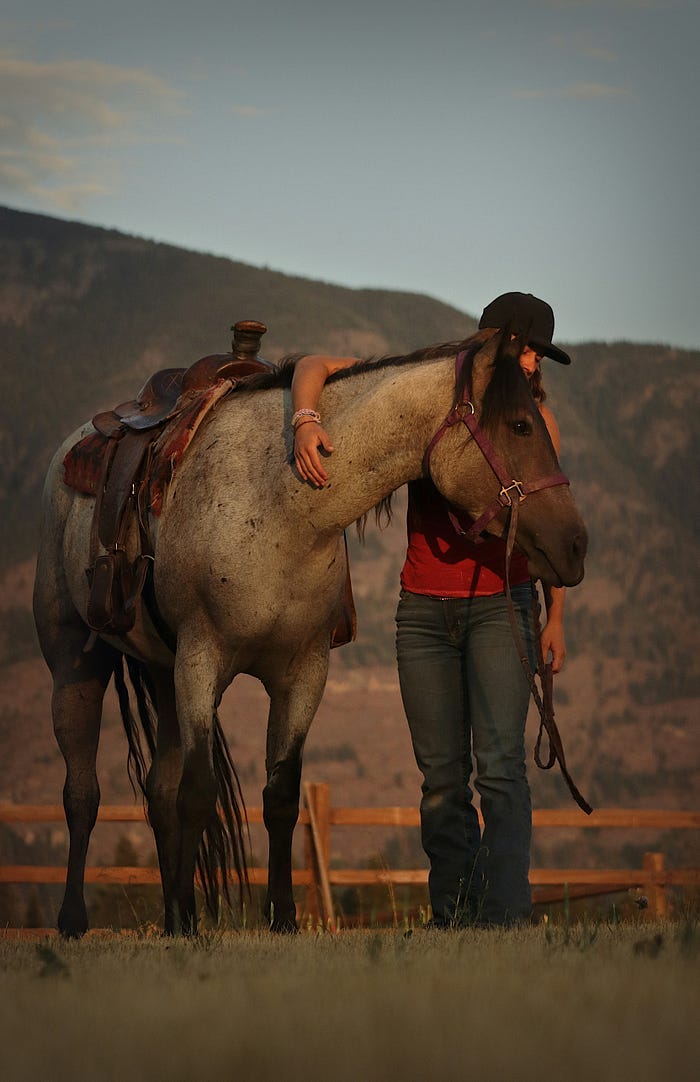
Photo by Live Kaiah on Unsplash
What Travel Sometimes Gives You
I’ve done a lot of things while traveling — some thrilling, some relaxing, some unforgettable for all the obvious reasons.
But this was different.
This wasn’t about adrenaline or scenery or even story.
This was about stillness.
About the quiet realization that the energy you carry — the thoughts you hold, the tension you don’t even know you’re gripping — doesn’t just live inside you. It radiates outward. It shapes how the world responds.
That horse didn’t come to me because I did something right.
He came because I finally stopped doing everything wrong.
And in that moment, standing in a dusty corral in the Texas Hill Country, I understood something I hadn’t expected to learn on a birthday trip:
Sometimes the most powerful journeys don’t take you anywhere at all.
They just bring you back… to a version of yourself you forgot was there.
That, I think, is the finest thing travel can do for you.